Voting has long been recognized as “preservative of all rights,”
Yick Wo v. Hopkins, 118 U.S. 356, 370 (1886)
Contents
Click the icon for opinions and facts based on rights, laws, and legal authorities.
Official’s protected vote
Elected officials have a right to vote to delay or deny certification of the canvass of an election for cause; their duty to investigate substantive evidence.
PRECINCT POLLING
Max. number increases access. Too few is discriminatory. Best for human assistance for the elderly and disabled. It is the county clerk or registrar of voters who determine the number and configuration of polling precincts.
SEPARATED BALLOTS
Nevada allows for different ballots for statewide races and questions versus local ones, even in a general election. Separate ballots empower counties/cities to self-audit.
HAND COUNTING
Nevada allows for hand counting, county choice.
PAPER BALLOTS ONLY
Voters’ right to a “uniform, statewide standard,” that is paper ballots only.
VOTER ID
Required Voter IDs is a constitutional amendment to be voted on in the 2026 election.
ERRORS AND OMISSIONS
A ministerial, non-discretionary statutory requirement that “the board shall: (a) Note separately any clerical errors discovered; and
(b) Take account of the changes resulting from the discovery”
VOTER SIGNATURE PROTECTIONS
Exposed signatures on ballot return envelopes violate the federal ID Theft and Assumption Deterrence Act.
RANKED CHOICE VOTING
An unconstitutional ballot initiative that voters’ will decide on in the 2026 election to change the state’s constitution.
VOTERS BILL OF RIGHTS
Nevadans added the Voters Bill of Rights to the Nevada Constitution in 2020.
COUNTY/TOWNSHIP RIGHTS
The Nevada Constitution art. 4 sec. 20 grants enumerated rights to counties and townships to regulate and conduct local elections and to investigate elections and election officials.
Prepared for 2026? You should be.
Official’s Protected Vote
An elected official’s vote cannot be deprived nor diluted.
The Disinformation of Francisco Aguilar
In Aguilar v. Commissioners Andriola, Clark, and Herman, Nevada Supreme Court, Case No. 88965, Secretary Aguilar argued that certification of the recount of two local races in Washoe County was a “ministerial, non-discretionary” duty of the Board of Commissioners (“Board”). He argued that NRS 293.387—canvass by the Board—is “facially clear.” He argued that the Board does not have the luxury of time to delay or deny certification, irrespective of concerns of Board members. And, he used threats and intimidation to get his way.
The Secretary has lost his way: The words “ministerial, non-discretionary” are not in Title 24 of the Nevada Revised Statutes. Suggesting otherwise is the epitome of disinformation. NRS 293.387 is actually vaporous and not clear as to a Board’s duty to delay or deny certification. In fact, the statute requires accuracy: “the true vote cast.” There are time limits but there is no statutory penalty for delay or denial of certification of a canvass, which is consistent with a public officials’ rights. And, the lawfare, threats, and intimidation used by the Secretary are unethical and inconsistent with Dunn v. Blumstein, 405 U.S. at 343, (quoting Shelton v. Tucker, 364 U.S. 479 (1960), “a State may not choose the way of greater interference. If it acts at all, it must choose ‘less drastic means.’”
The Secretary has turned a public official’s duty to investigate substantive evidence of malfunction or malfeasance into a criminal act. But, to ignore substantive evidence by a public official could be a neglect of duty pursuant to NRS 202.595 as to a ballot as property and NRS 283.440(2b) as to performing official duties.
Rather, it is the Secretary who has ignored the facts, suppressing any investigation of the election systems or modes of implementation of the system.
In People ex Rel. Chamberlin v. Trustees of Schools, 97 Ill. 627, 632 (1881), “a failure to deny material facts well pleaded is an admission of their truth.”
The Rights of Public Officials has been Adjudicated
The Nevada Supreme Court and the United States Supreme Court have already weighed in on a public official’s right to vote their conscience.
“The State District Court denied the petition, but the Nevada Supreme Court reversed, holding that voting is protected speech,” Nevada Commission on Ethics v. Carrigan, 564 U.S. 117 (2011). Mr. Carrigan was a Sparks City Councilman whose case set legal precedent applicable today.
“(T)he county board is bound to consider the interests of all of its citizens,” Clark Cnty. V. City of Las Vegas, 92 Nev. 323, 550 P.2d 779 (citing McDonough v. Roach, 35 N.J. 153, 171 A.2d 307 at 309-310 (1961). Local jurisdictions have autonomy to address matters of local concern. County and city elections are of local concern.
County Rights and Differing Elections
There are different rights of counties for different elections pursuant to Nev. Const. art. 4, § 20, which lists a number of ‘enumerated rights’ including:
– Regulating the election of county and township officers;
Hence, the county has rights to self-regulate the races for county commission and school board trustee, as the case may be.
In Clark Cnty. V. City of Las Vegas, 94 Nev. 74, 574 P.2d 1013, 1014 (1978), the Nevada Supreme Court recognized and affirmed that county and city rights in elections cannot be abridged pursuant to Nev. Const. art. 4, § 20.
However, when the Washoe County Board of Commissioners merely discussed self-audit of recounts of county commission and school board races back in July, it was met with swift opposition by the Secretary of State.
Threats and Intimidation
After filing suit, the Secretary, a democrat, attacked the republican Board members on social media with veiled threats of criminality, using such words as “the potential to set a dangerous precedent” and “would undermine confidence in our democracy.”
Under such duress, the Board of Commissioners approved the recounts and the case was closed by the Court.
But then, the Secretary filed an extraordinary petition to re-open the moot case, based on wild speculation and colorful language:
“catastrophic disruption in the general election,” p. 1;
“The threat of rogue county commissioners flouting their ministerial duty to canvass elections results will only continue to grow,” p. 6;
And he blasted the good people of Washoe County:
“baseless attacks against election results,” p. 3;
“conspiratorial public comments,” p. 4.
The Secretary is derogatory to the point of bias by inferring or implying that the public is seditious, launching “attacks against election results” in a “conspiratorial” manner. Is the public now the enemy, according to the Secretary?
The Nevada Supreme Court denied the Secretary’s petition, thank goodness, but left the door open for him to file lawsuits against public officials in state district court.
As it stands now, public officials who dare to question the results handed to them by a clerk or registrar of voters will be sued by the Secretary. Such a looming threat casting more doubt and dispersions than trust among voters, candidates, and county and city commissioners.
Workplace Harassment/Election Interference
By attempting to re-open a moot case based on “the threat of rogue commissioners…”, the Secretary’s actions have the appearance of harassment under the law.
The Secretary’s inference of criminality has resulted in the intended consequences—the obstruction of county business and coercion of the vote of Board members. Violations of NRS 33.240, NRS 293.710 and NRS 293.2546(3), “To vote without being intimidated, threatened or coerced.”
Abuse of Government Resources
Seeking an opinion from the Nevada Supreme Court to re-open a moot case, one that should have never been brought to the high court in the first place, in a preemptive strike when the proper venue, if there are provable concerns, is district court.
Closing
Put it all together and the Secretary’s actions are partisan, unethical, and unlawful.
All public officials must vote their conscience when problems exist such as irrefutable evidence of manipulated results from the 2024 primary. The law is on their side.
Precinct Voting
A foundation of our Constitutional Republic.
A maximum number of polling locations increases access, whereas too few locations is discriminatory. This issue was ruled upon by the U.S. Supreme Court in Brnovich v. Democratic National Committee, 594 U.S. 647 (2021):
Justice Alito maintained that it was “very easy to vote” under Arizona’s current process and that expecting state residents to identify their correct polling location and then travel to that location did “not exceed the ‘usual burdens of voting.’”
In addition, precinct voting provides hands-on support by election officials for the elderly, disabled, and the language challenged voter, unmatched by other methods of voting.
ELECTION PRECINCTS
NRS 293.205 Establishment, abolishment, alteration and consolidation; boundaries.
NRS 293.206 Submission of maps to Secretary of State and Legislative Counsel Bureau; determination of statutory compliance; revisions.
NRS 293.207 Establishment on basis of number of voters therein; maximum number of voters; consolidation of precincts.
NRS 293.208 Limitations on creation, division, abolition, consolidation and alteration during certain periods; exceptions.
NRS 293.209 Creation or change of election district during certain period in year of general or general city election prohibited; annexation not prohibited during year of election.
NRS 293.210 Establishment of new election precinct: Petition and conditions.
NRS 293.207 Establishment on basis of number of voters therein; maximum number of voters; consolidation of precincts.
1. Election precincts must be established on the basis of the number of registered voters therein, with a maximum of 5,000 registered voters who are not designated inactive pursuant to NRS 293.530 per precinct in those precincts in which a mechanical voting system is used.
2. Except as otherwise provided in subsections 3 and 4, the county clerk may consolidate two or more contiguous election precincts into a single voting district to conduct a particular election as public convenience, necessity and economy may require.
NRS 293.210 Establishment of new election precinct: Petition and conditions. Except as otherwise provided in NRS 293.208, a new precinct may be established upon petition of 10 or more registered voters, permanently residing in the area sought to be constituted a precinct, stating that they reside more than 10 miles from any polling place in the county. If it appears to the satisfaction of the county clerk that not less than 50 registered voters reside in the area, the precinct may be established without regard to the distance which the registered voters reside from another polling place or precinct.
Separated Ballots
And with it is a right to self-audit and/or investigate.
Ballots differ between local and special elections, such as a recall or replacement of a mayor, and local ballot questions versus statewide elections and ballot questions.
Separate ballots are allowed pursuant to Nevada Constitution art. 4, § 20, “Regulating the election of county and township officers; Providing for opening and conducting elections;” and NRS 293.2694(2), “Each board of county commissioners and governing body of an incorporated city in this State may elect to use the ballots, including, without limitation, mail ballots, and return envelopes purchased by the Secretary of State.” (emphasis added)
If a city or county uses a ballot separate from state and presidential races, the Secretary of State has no authority to intervene as long as the laws and codes are followed. The city or county is free to self-audit their ballots and the systems used to process those ballots.
Indeed, the city or county may investigate elections and election officials, too, per Nev. Const. art. 4 § 20, “Summoning and impaneling grand and petit juries, and providing for their compensation;”
Hand Counting
Accurate, transparent, and cost-effective.
Consistent with a county’s right to choose methods of conducting elections, including choice of equipment/software, separate ballots, and number of precinct polling locations, they also have the option to hand count ballots.
Nevada Revised Statutes give local jurisdictions choice to use equipment or not:
NRS 244.194 Voting or counting devices: Rental, lease or other acquisition. Boards of county commissioners may rent, lease or otherwise acquire voting or counting devices in whatever manner will best serve local interests.
NRS 293.269925 Establishment of procedures for processing and counting mail ballots. 1. The county clerk shall establish procedures for the processing and counting of mail ballots. 2. The procedures established pursuant to subsection 1: (a) May authorize mail ballots to be processed, verified and counted by computer or other electronic means;
NRS 293.3075 Requirements for casting ballots at vote centers. [Effective January 1, 2025.] 6. If the ballot is voted on a mechanical recording device which directly records the votes electronically, the election board officer shall:
NRS 293B.105 General authority. The board of county commissioners of any county or the city council or other governing body of any city may purchase and adopt for use at elections any mechanical voting system and mechanical recording device. The system or device may be used at any or all elections held in the county or city, for voting, registering and counting votes cast.
NRS 293B.110 Adoption of different systems or devices for different precincts or districts. A mechanical voting system or mechanical recording device may be adopted for some of the precincts or districts in the same county or city, while the remainder of the precincts or districts in that county or city may be furnished with paper ballots or any other mechanical voting system or mechanical recording device.
Exception NRS 293.2955 Accessibility of polling place, ballot and election materials to persons who are elderly and to persons with disabilities; particular requirements regarding voting booths and waiting lines; alternative placement of specially equipped voting devices at centralized locations. See Sections 1 and 4.
Nevada Administrative Code gives guidance on how to perform hand counting:
PROCESSING AND HAND COUNT OF BALLOTS; RETURNS; REPORTS
293.3555 Recess of counting procedure.
293.356 Requirements for persons to observe processing and counting of ballots at central counting place.
293.35611 Hand count of ballots: Standards; deadline; forms.
293.35613 Submission of plan to Secretary of State relating to hand count of ballots; requirements.
293.35615 Hand count tally team: Composition; workspace.
293.35617 Hand count of ballots: Preparation of ballots; method of hand counting; verification of count; supervision or assistance by Secretary of State upon request of county clerk.
293.35619 Hand count tally team: Writing devices provided by county clerk.
293.357 Reporting of returns from early voting and mail ballots in combination with regular votes of precinct.
293.3573 Primary election for nonpartisan offices: Determination of candidate receiving majority of votes.
293.358 County abstract: Contents; combining of precincts.
293.359 Mechanized report of abstract.
293.3593 Certain summaries of votes are public records.
293.3595 Reporting requirements after election.
“As it turns out, for all that technology has brought us, good and bad, the best way to conduct secure elections? Paper ballots.”
-Former Vice President Kamala Harris
Paper Ballots Only
Voters’ right to a paper ballot is our history and legacy.
Nevada has offered its citizens a paper ballot since statehood. Casting of a paper ballot is our legacy and our right as a result. Voters enacted the Voters Bill of Rights in 2020, granting rights to a “uniform, statewide standard.” Nevada does not provide a uniform standard ballot or method of transmission of a ballot.
- Adoption of electronic ballots has split the statewide standard for counting/recounting pursuant to Nev. Const. Art 2 Sec 1A § 10 and NRS 293.2546 (10).
- Paper ballots at the polls are cost effective compared to electronic systems.
- Paper ballots at the polls are the most trusted and secure method of voting; a record on paper is required by law.
- Paper is an essential element for election security and auditing. (NRS 293.2696 (4), NRS 293B.082, NRS 293B.330 (1)(b)(1)(I), and NRS 293B.400)
- In comparison, electronic voting systems are not trustworthy, are non-transparent, and are prone to errors, glitches, and human intervention.
By using paper ballots at the polls, the county and ROV can eliminate known vulnerabilities associated with the electronic systems while maximizing transparency and accountability, which are in the voter’s best interests.
“People showing up, people actually showing ID, is still the easiest system to assure total integrity.”
-Former Gov. Andrew Cuomo, D-N.Y.
Voter ID
“To preserve the purity of elections,” Nevada Constitution art. 2 sec. 6
The U.S. Supreme Court has ruled that requiring proper voter ID is neither discriminatory nor unconstitutional:
“The burden of acquiring, possessing, and showing a free photo identification is simply not severe, because it does not “even represent a significant increase over the usual burdens of voting.”
CRAWFORD V. MARION COUNTY ELECTION BOARD, 553 U.S. 181 (2008)
Errors and Omissions
A duty and an obligation to accept errors and to investigate substantive evidence of wrongdoing.
Currently, the county clerk or registrar of voters is not required to report errors and omissions in their canvass of an election, or the recount of an election; no statute, state code, or county ordinance mandates such disclosures. However, they are required to accept errors and their correction and to resolve substantive evidence of election fraud, malfeasance, unnatural results, and the like. And they are required, in the event of a cyberattack, to alert state officials.
Let’s break it down.
NRS 293.387 Canvass of returns; abstract of votes.
2. In making its canvass, the board shall:
(a) Note separately any clerical errors discovered; and
(b) Take account of the changes resulting from the discovery, so that the result declared represents the true vote cast.
NRS 293.387 is facially clear as to the duty imposed on commissioners to 1) note the discovery of an error and its correction, and 2) certify any changes to represent the true vote cast.
And, as explained above in Official’s Protected Vote, pursuant to NRS 293.387, investigating the cause of an error is a ministerial, non-discretionary duty of the board.
To ignore an error is a neglect of duty, or gross negligence, pursuant to NRS 202.595 as to a ballot as property and NRS 283.440(2b) as to performing official duties.
The Nevada Supreme Court has described gross negligence as an “indifference to present legal duty . . . [an] utter forgetfulness of legal obligations so far as other persons may be affected.” Hart v. Kline, 61 Nev. 96 (1941).
To certify an inaccurate result could be akin to perjury by commissioners and/or the ROV pursuant to NRS 199.120 and NRS 199.150.
People ex Rel. Chamberlin v. Trustees of Schools, 97 Ill. 627, 632 (1881), states that “a failure to deny material facts well pleaded is an admission of their truth.”
City of Philadelphia v. MacDonald, 464 Pa. 430, 437 (1975), notes that “a failure by the defendant to properly deny such allegations constitutes an admission of the failure to exhaust such remedies.”
In fact, the Nevada Constitution art. 4 sec. 20 provides for investigation of elections: “Summoning and impaneling grand and petit juries, and providing for their compensation.”
And, NRS 293.225, 2. “Each member of an election board is subject to call by the board of county commissioners or city council to correct any errors discovered during the canvass of votes by the board of county commissioners or city council.”
Yet, despite the statutory requirement to note errors and the right to investigate such things, there is little to no transparency from election officials and investigations are lacking.
Voter Signature Protections
A signature is non-public information, protected by the ID Theft and Assumption Deterrence Act.
Nevada’s ballot return envelopes expose voters’ signature, name, and address, making them ripe for the pickings by identity thieves and forgers as shown here:
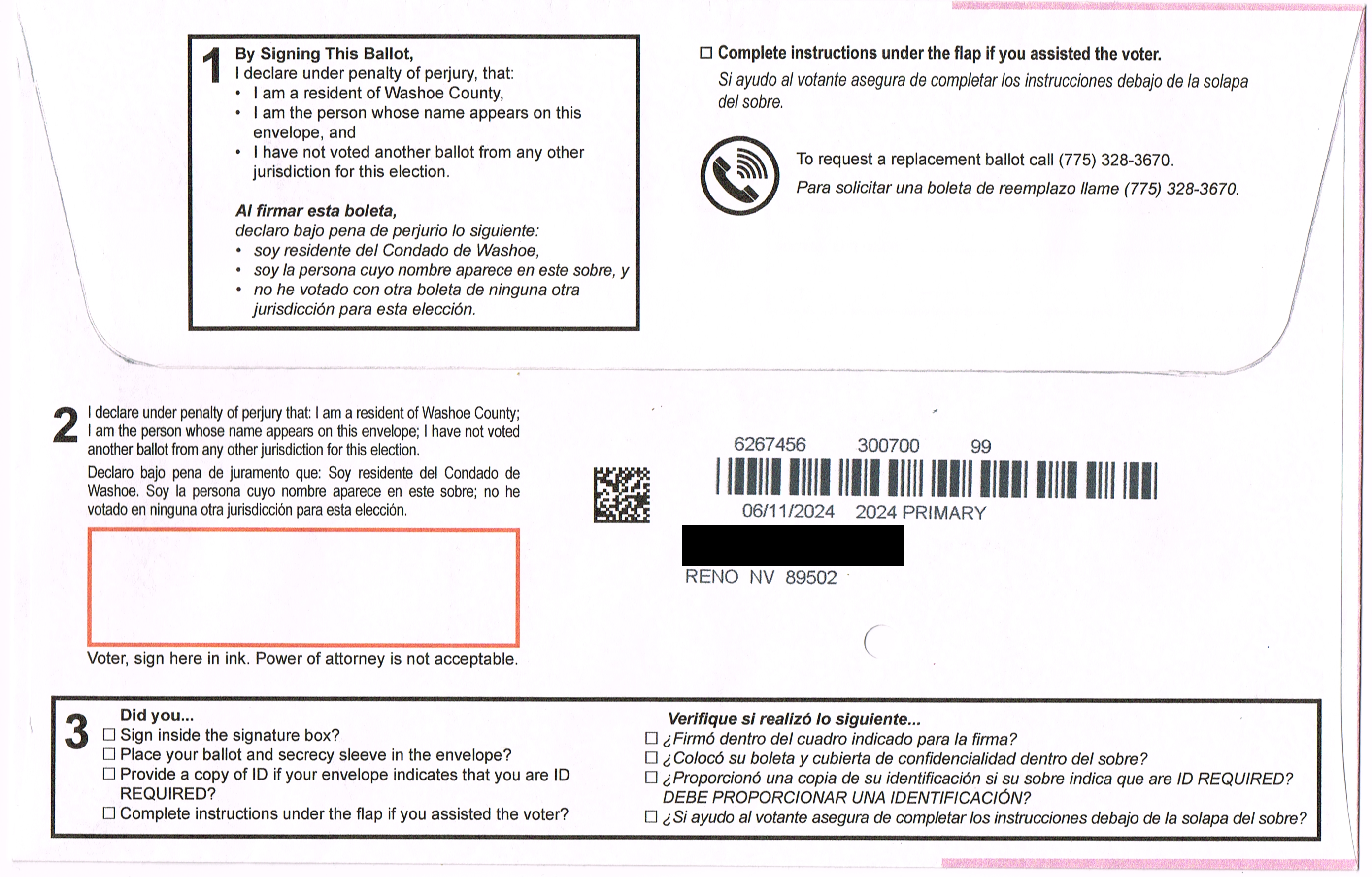
Ballot return envelopes have seen a stark design shift. Historically, return envelopes featured a security flap concealing signatures, safeguarding voter privacy. But in recent elections, the Secretary of State moved the signature block to below the privacy flap, fully exposing it. This move appears to flaunt statute as follows:
NRS 293.2696 mandates that voting systems “secure to each voter privacy and independence.”
The ballot return envelope does not warn of any risks, or that another method of voting carries less risk. The lack of a proper warning of potential identity theft when mailing a ballot is a violation of Consumer Protection rights pursuant to 15 U.S.C. § 7001 (B).
The U.S. Department of Justice warns:
With enough identifying information about an individual, a criminal can take over that individual’s identity to conduct a wide range of crimes. For example:
• False applications for loans and credit cards,
• Fraudulent withdrawals from bank accounts,
• Fraudulent use of telephone calling cards or online accounts, or
• Obtaining other goods or privileges which the criminal might be denied if he were to use his real name
Identity theft and forgery goes well beyond elections, sometimes utilizing high tech methods, according to a recent report at TechSpot by Skye Jacobs, stating:
“Cybercriminals are using AI-driven bots to impersonate students, enroll in online college courses, and divert financial aid, leaving real individuals with stolen identities and fraudulent debt.”
The stakes are high. In 2022, the total of victim losses due to identity theft in Nevada amounted to $127,315,394, according to the FBI’s 2022 Internet Crime Report, page 26.
Instead of being accurate and safe to use, Nevada’s return ballot envelopes endanger voters, turning the right of suffrage—a sacred civic duty—into a gamble with identity and the integrity of elections. The ultimate outcome being, voters feel disenfranchised and/or disincentivized to participate in elections.
State officials have fumbled the ball, and the federal government can’t afford to let this slide. The people deserve better: privacy envelopes, protected identities, and a process they can trust.
Ranked Choice Voting
Undermines one person-one vote, which is a foundation of our elections.
Election by plurality.
NEVADA CONSTITUTION ARTICLE 15 § 14
A plurality of votes given at an election by the people, shall constitute a choice, where not otherwise provided by this Constitution[.]
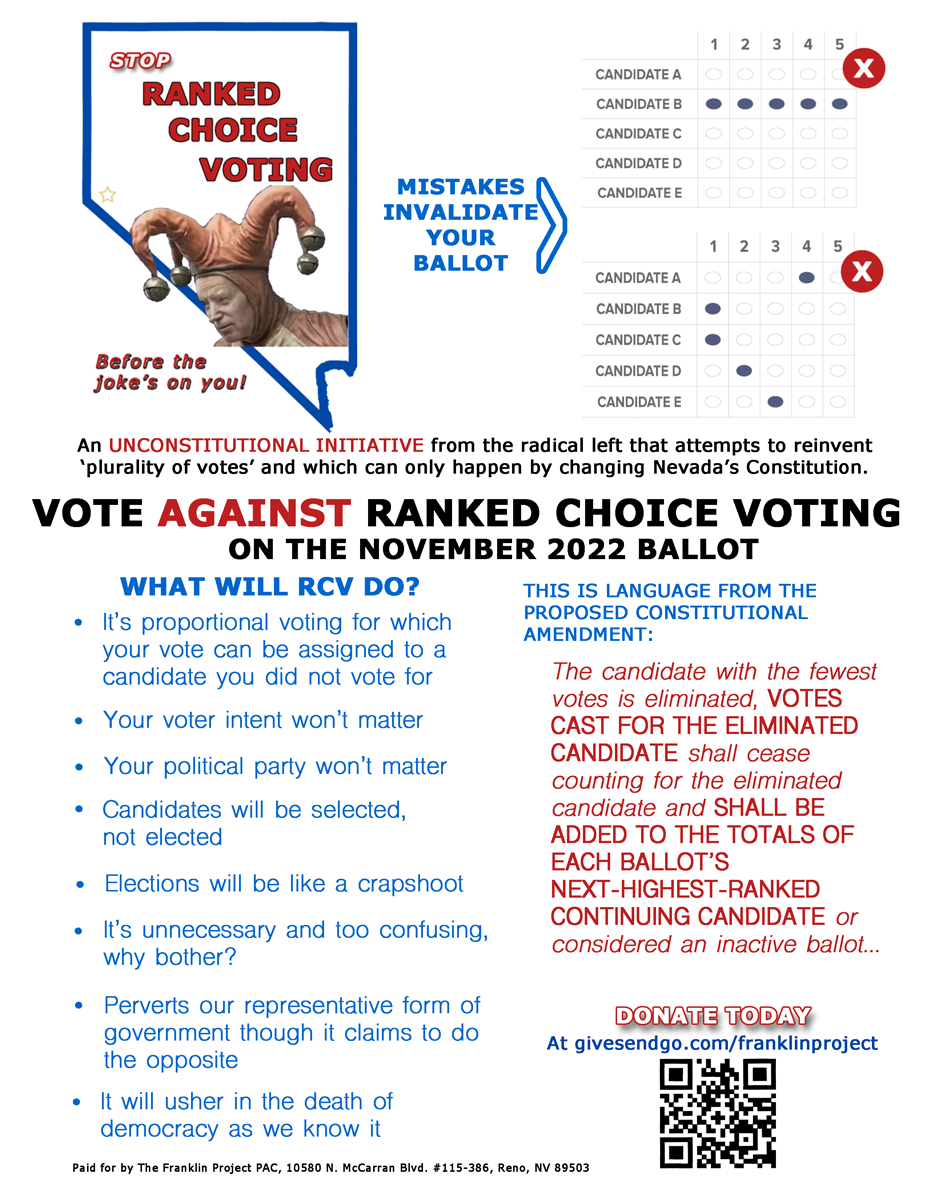
Ranked Choice Voting allows a voter to cast votes for their top favored candidates of any political party in numbered preference. If their number one choice does not garner over 50% of the popular vote, that race is recounted after the candidate with the lowest votes is eliminated and his/her votes then attributed to the next lowest candidate. The process is repeated until a candidate is found to have over 50% of the vote. Sounds insane, doesn’t it?
For the voters who only voted for one and only one candidate in a race, if their candidate fails in the first round, their ballot is set aside. This is called ‘ballot attrition.’ Statistics of ballot attrition are allegedly near 20 percent in the elections in those states using RCV. That would appear to be contrary to an accurate account of the will of the people.
Ranked Choice Voting is a constitutional amendment ballot initiative that voters will decide on in 2026.
Please, vote No on RCV!
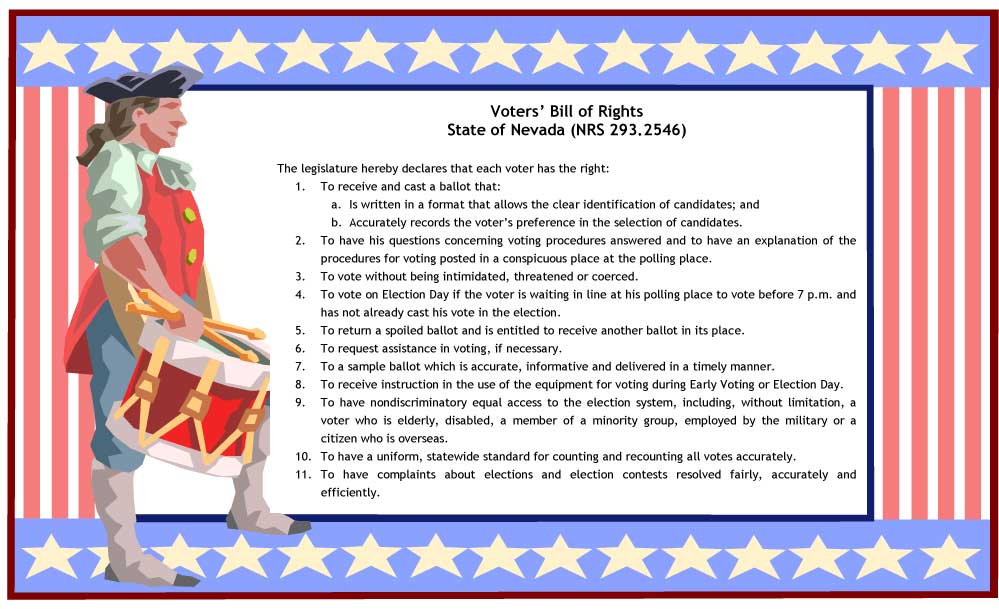
Voters Bill of Rights
Ratified in 2020, codified in NRS 293.2546.
County/Township Rights
Enumerated rights cannot be deprived nor diluted.
THE NEVADA CONSTITUTION
Article 4 Section 20. Certain local and special laws prohibited.
The legislature shall not pass local or special laws in any of the following enumerated cases—that is to say:
- Summoning and impaneling grand and petit juries, and providing for their compensation;
- Regulating county and township business;
- Regulating the election of county and township officers;
- Providing for opening and conducting elections of state, county, or township officers, and designating the places of voting;